
Cleanroom Classifications: ISO Classes 1–9, FS 209E and EU GMP Grades
Published by Harmony Lab & Safety Supplies on Oct 20, 2026
Updated October 2026 · Harmony Lab & Safety Supplies
Cleanrooms are classified by how many airborne particles they allow per cubic meter of air. The international standard, ISO 14644-1:2015, defines nine classes, from ISO 1 (cleanest) to ISO 9. Older US names such as “Class 100” and “Class 10,000” come from FED-STD-209E, which was cancelled in 2001 but is still used on many spec sheets. Sterile pharmaceutical sites in Europe use EU GMP grades A to D. This guide puts all three systems side by side and shows what is typically worn and used in each class.
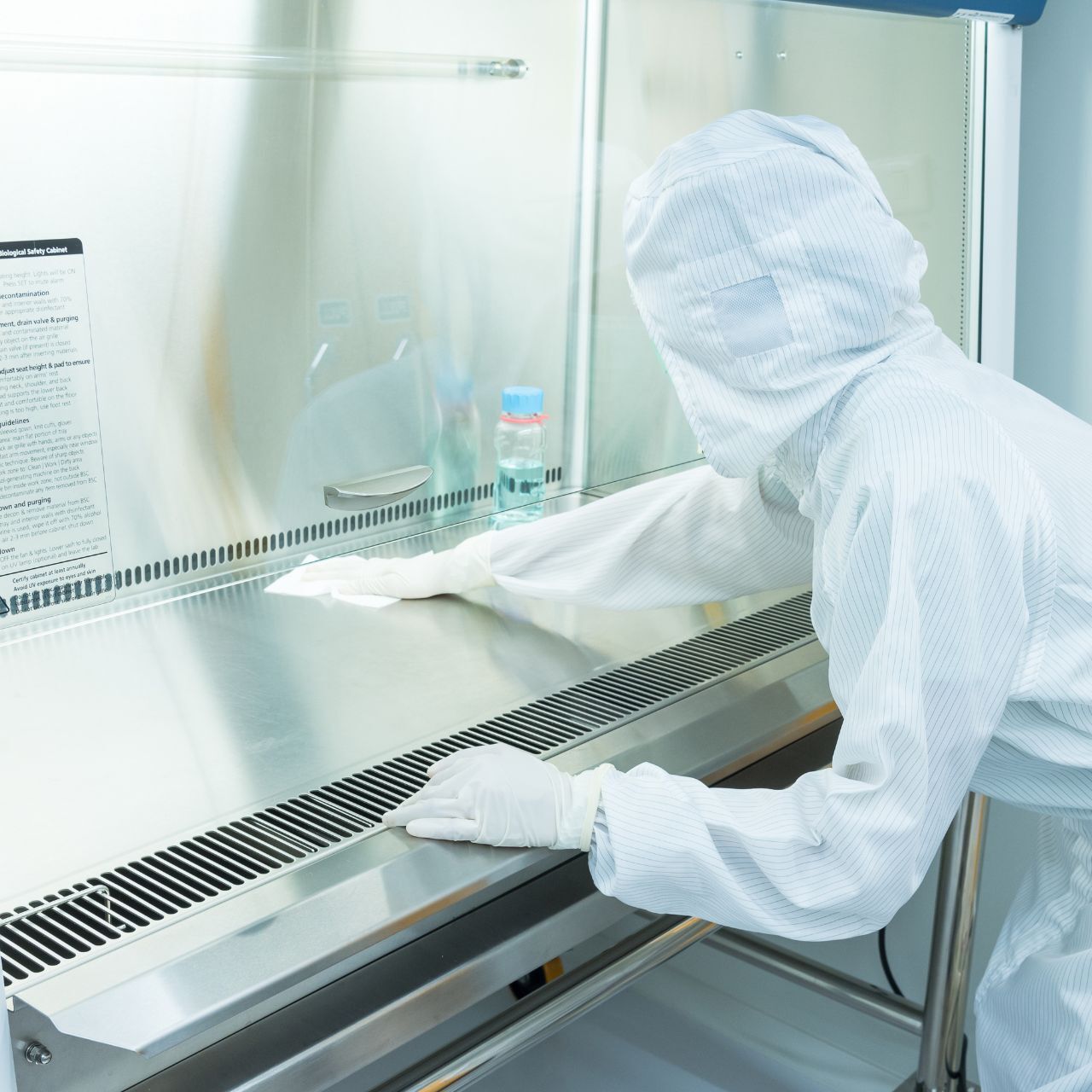
ISO 14644-1 cleanroom classification table
Each number is the maximum concentration of particles per cubic meter of air that are equal to or larger than the size shown. The limits are cumulative: a count “at 0.5 µm” includes every particle 0.5 µm and bigger.
| ISO class | ≥0.1 µm | ≥0.2 µm | ≥0.3 µm | ≥0.5 µm | ≥1 µm | ≥5 µm |
|---|---|---|---|---|---|---|
| ISO 1 | 10 | – | – | – | – | – |
| ISO 2 | 100 | 24 | 10 | – | – | – |
| ISO 3 | 1,000 | 237 | 102 | 35 | – | – |
| ISO 4 | 10,000 | 2,370 | 1,020 | 352 | 83 | – |
| ISO 5 | 100,000 | 23,700 | 10,200 | 3,520 | 832 | – |
| ISO 6 | 1,000,000 | 237,000 | 102,000 | 35,200 | 8,320 | 293 |
| ISO 7 | – | – | – | 352,000 | 83,200 | 2,930 |
| ISO 8 | – | – | – | 3,520,000 | 832,000 | 29,300 |
| ISO 9* | – | – | – | 35,200,000 | 8,320,000 | 293,000 |
*ISO Class 9 limits apply to the operational state only. A dash means the standard sets no limit for that size in that class. Source: ISO 14644-1:2015, Table 1.
Each class allows ten times more particles than the class below it. Behind the table is a formula: the limit for class N at particle size D (in µm) is 10N × (0.1/D)2.08, rounded.
How a cleanroom class is stated
A classification is only complete when it names three things: the ISO class, the particle size or sizes counted, and the occupancy state. ISO 14644-1 defines three states:
- As-built: the room is complete with services connected, but no production equipment or people.
- At-rest: equipment is installed and running, but no personnel are present.
- Operational: the room is working as intended, with the specified number of people.
So a full specification reads like “ISO Class 5, operational, at 0.5 µm”. The same room can hold a tighter class at rest than in operation, because people are one of the biggest sources of particles. That is why the gowning and cleaning steps below matter as much as the air filtration. ISO 14644-2 then covers the monitoring that shows the room keeps meeting its class over time.
FS 209E vs ISO 14644-1: equivalent classes
FED-STD-209E counted particles of 0.5 µm and larger per cubic foot, and named each class after that count. The US General Services Administration cancelled it on 29 November 2001 in favor of ISO 14644-1. Because the 209E names are short and familiar, product spec sheets still use them. A notebook or glove rated for “Class 100” is meant for an ISO 5 environment.
| FS 209E class | ISO 14644-1 equivalent | ISO limit at ≥0.5 µm per m³ |
|---|---|---|
| Class 1 | ISO 3 | 35 |
| Class 10 | ISO 4 | 352 |
| Class 100 | ISO 5 | 3,520 |
| Class 1,000 | ISO 6 | 35,200 |
| Class 10,000 | ISO 7 | 352,000 |
| Class 100,000 | ISO 8 | 3,520,000 |
The match is close rather than exact: one cubic foot is about 0.0283 m³, so 100 particles per cubic foot is about 3,530 per m³, against the ISO 5 limit of 3,520.
EU GMP grades A to D
Sterile medicine manufacturing in Europe follows EU GMP Annex 1 (revised 2022), which uses grades instead of ISO classes. Each grade has limits at rest and in operation. The particle limits below are from Annex 1, Table 1, per m³ at ≥0.5 µm. The ISO column shows which ISO 14644-1 limit those numbers match.
| Grade | At rest | In operation | Matches | Typical use |
|---|---|---|---|---|
| Grade A | 3,520 | 3,520 | ISO 5 at rest and in operation | High-risk aseptic operations, such as filling and open sterile product |
| Grade B | 3,520 | 352,000 | ISO 5 at rest, ISO 7 in operation | Background room for Grade A in aseptic preparation and filling |
| Grade C | 352,000 | 3,520,000 | ISO 7 at rest, ISO 8 in operation | Less critical steps in sterile manufacturing |
| Grade D | 3,520,000 | Set by the manufacturer | ISO 8 at rest | Less critical steps in sterile manufacturing |
Annex 1 also sets limits for microbial contamination, which are not covered here. In US sterile compounding, USP <797> uses ISO classes directly: compounding happens in an ISO 5 primary engineering control, inside an ISO 7 buffer room entered through an ISO 7 or ISO 8 ante-room. Check the current chapter and your state board of pharmacy for the rules that apply to you, and see our compounding pharmacy supplies.
What to wear and use in each class
The standards above define air cleanliness. They do not list garments or supplies, so these are set by each facility’s procedures (often based on IEST recommended practices) and, for pharmaceutical sites, by Annex 1. The table shows typical practice. Your SOP and contamination control strategy take precedence.
| Class | Typical garments | Typical consumables |
|---|---|---|
| ISO 8 (Class 100,000) |
Bouffant cap or hair net, beard cover, frock or lab coat, shoe covers, gloves | Poly-cellulose wipes, cleanroom paper and pens, tacky mats |
| ISO 7 (Class 10,000) |
Adds a coverall in many facilities, plus a hood, boot covers and a face mask | Cleanroom wipes, pre-saturated IPA wipes, cleanroom notebooks |
| ISO 6 (Class 1,000) |
Coverall, hood, boot covers, face mask and gloves, with no skin or hair exposed | Polyester wipes, cleanroom swabs, cleanroom tape |
| ISO 5 (Class 100) |
Full coverage: hood, coverall, boots, mask, goggles and gloves, often double-gloved. Sterile garments for aseptic work | Polyester knit wipes, sterile wipes and sterile IPA for aseptic areas |
For pharmaceutical sites, Annex 1 is specific. Grade D needs hair and beard covered, a general protective suit and disinfected shoes or overshoes. Grade C adds a trouser suit gathered at the wrists with a high neck. Grade B, and any work in Grade A, needs sterile headgear, a sterile face mask, sterile eye coverings, sterile gloves and sterilized footwear such as over-boots, worn over a sterile suit.
For the full donning and de-gowning sequence, see our cleanroom gowning procedure. For a broader overview of garment types, see the cleanroom PPE guide.
Choosing products for your class
- Check the rated class on the spec sheet. Gloves, wipes, paper and garments are usually rated for a class, either as ISO or as the 209E name. A product rated for a cleaner class can be used in a less clean one, not the other way round.
- Match the wipe to the class. Knitted polyester wipes shed the fewest particles and fibers and are the usual choice for ISO 5 and cleaner. Polyester-cellulose blends absorb more and cost less, and are common in ISO 6 to 8. See how to choose cleanroom wipes.
- Look at packaging. Double-bagged packaging lets you remove the outer bag in the airlock. Sterile (irradiated) products are needed where the process requires sterility, such as aseptic areas.
- Keep paper, pens and tape cleanroom-grade. Ordinary paper, pencils and erasers shed particles. Use cleanroom documentation supplies instead.
- Plan the cleaning program with the class. Cleaner classes need tighter cleaning frequencies and lower-linting tools. See our cleanroom cleaning procedure.
Browse everything by category in cleanroom supplies, or contact us for help matching products to your class.
Frequently asked questions
What is the cleanest cleanroom class?
ISO Class 1, which allows no more than 10 particles of 0.1 µm or larger per cubic meter. In practice, most manufacturing cleanrooms run between ISO 5 and ISO 8.
What is an ISO 7 cleanroom?
A room that holds no more than 352,000 particles of 0.5 µm or larger per cubic meter. It is the ISO equivalent of an FS 209E Class 10,000 room.
What is an ISO 8 cleanroom?
A room that holds no more than 3,520,000 particles of 0.5 µm or larger per cubic meter, equivalent to FS 209E Class 100,000. It is the least strict class in common use for controlled manufacturing.
Is a Class 100 cleanroom the same as ISO 5?
Yes, for practical purposes. Class 100 allows 100 particles of 0.5 µm or larger per cubic foot, and ISO 5 allows 3,520 per cubic meter, which is about the same concentration.
Is FED-STD-209E still valid?
No. It was cancelled in 2001 and replaced by ISO 14644-1. Its class names are still widely used as shorthand.
Related guides
- What is a cleanroom?
- Cleanroom gowning procedure: donning and doffing steps
- Cleanroom cleaning and disinfection procedure
- A guide to cleanroom PPE
- How to choose cleanroom wipes
Sources
- ISO 14644-1:2015, Cleanrooms and associated controlled environments, Part 1: Classification of air cleanliness by particle concentration
- EU GMP Annex 1, Manufacture of Sterile Medicinal Products (2022), Table 1 and section 7.13
- FED-STD-209E, Airborne Particulate Cleanliness Classes in Cleanrooms and Clean Zones, cancelled by the US General Services Administration on 29 November 2001
- USP General Chapter <797>, Pharmaceutical Compounding: Sterile Preparations